

Affiliate Disclosure: This site contains affiliate links. We may earn a commission at no extra cost to you.
If you’ve ever opened a pack of Pokémon cards and immediately flipped through looking for the “good cards,” you’re definitely not alone. But when you’re new to collecting, figuring out exactly what you pulled can get confusing pretty quickly.
Why does one card have a circle while another has a diamond? What do two stars mean? And what’s the difference between an Illustration Rare and a Special Illustration Rare?
Understanding Pokémon card rarity gets much easier once you know what you’re looking for. The symbols printed on the cards can help you determine their rarity and better understand what you’ve pulled from a pack.
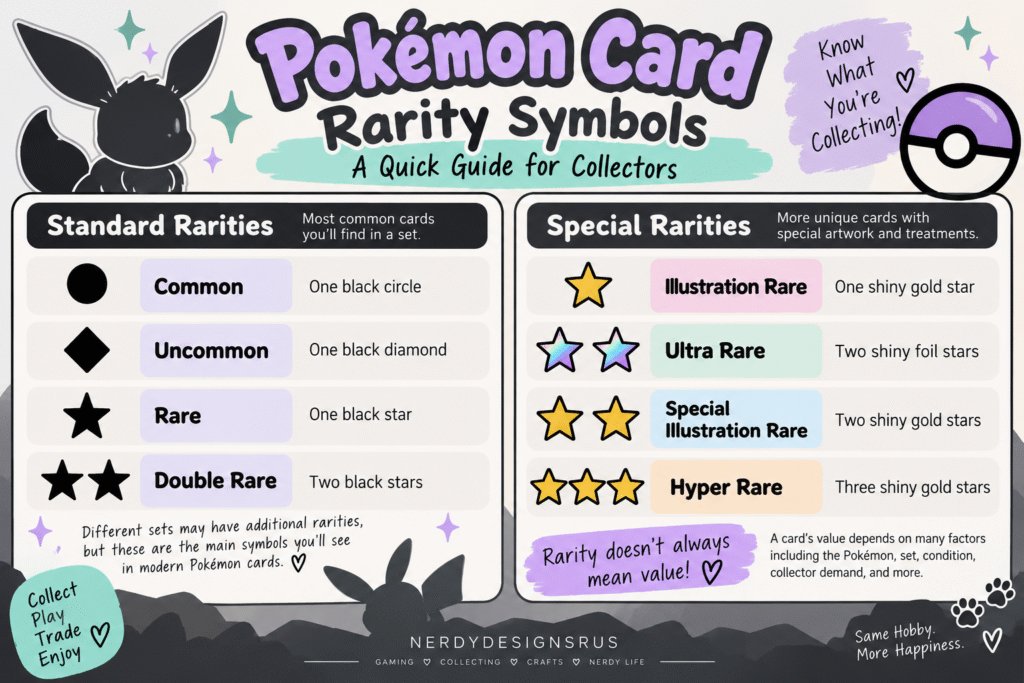
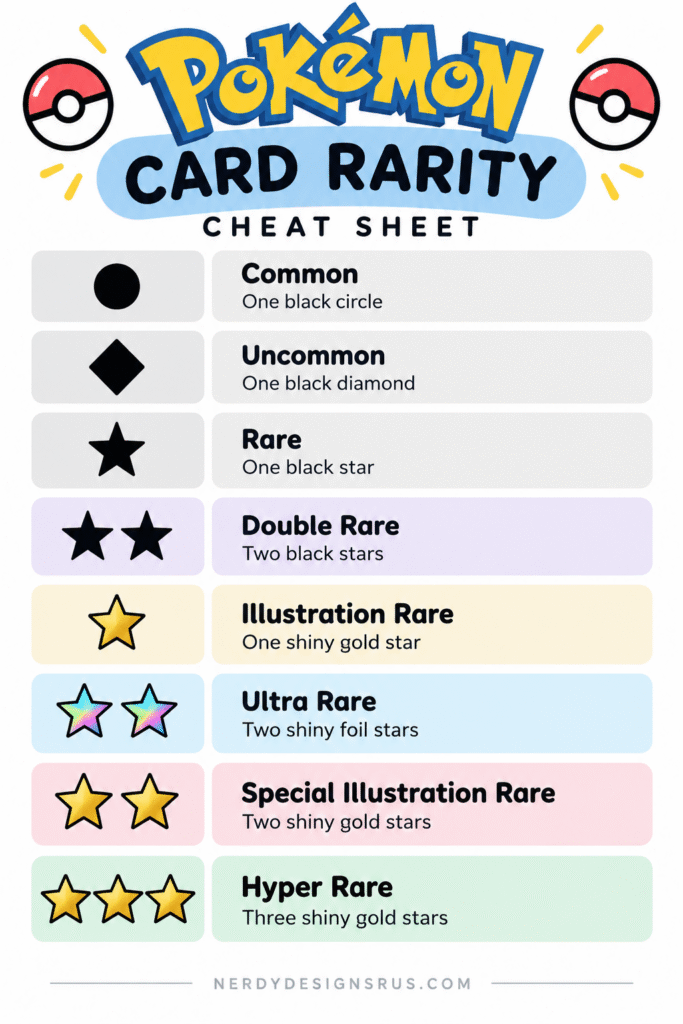
In this guide, we’re breaking down the Pokémon card rarity system in simple terms, including Common, Uncommon, Rare, Double Rare, Illustration Rare, Ultra Rare, Special Illustration Rare, and Hyper Rare cards.
What Does Rarity Mean on a Pokémon Card?
Rarity is a classification used within Pokémon TCG expansions to distinguish different cards in a set.
For collectors, the rarity symbol gives you a quick way to identify the general rarity category your card belongs to.
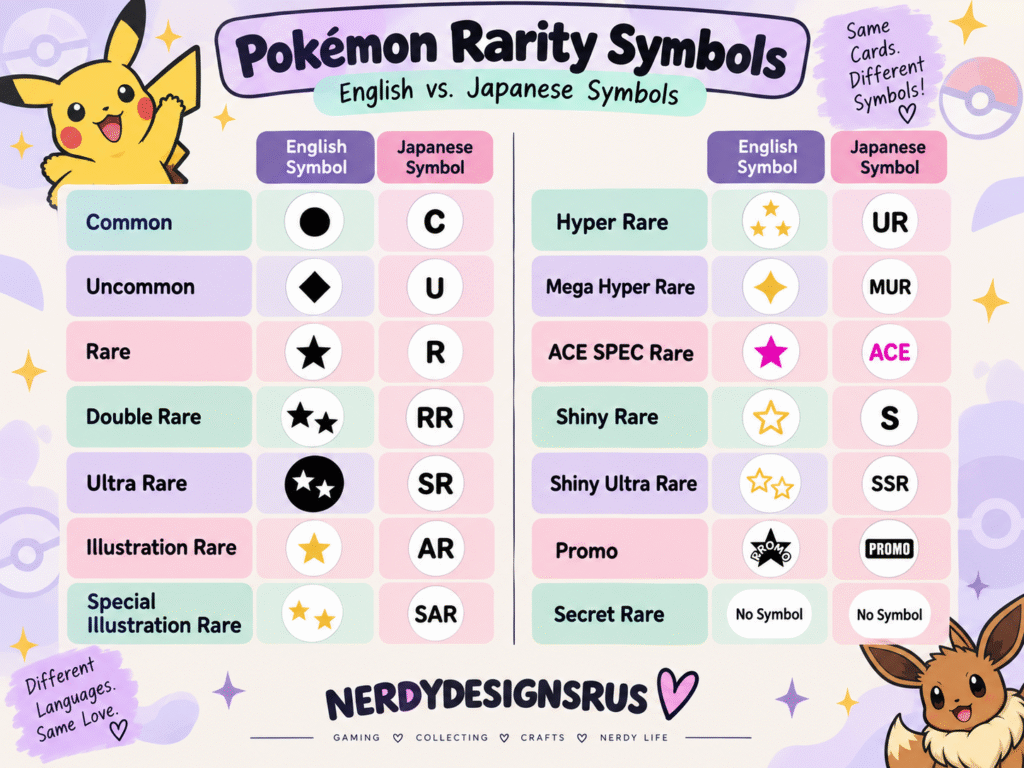
The modern Pokémon TCG uses several different symbols. In the Scarlet & Violet era, Pokémon retained the familiar circle, diamond, and star for Common, Uncommon, and Rare cards while introducing additional star-based symbols for higher rarity classifications.
Once you learn what those symbols mean, sorting through a new pack—or a giant box of cards—becomes much easier.
Where Do You Find the Rarity Symbol on a Pokémon Card?
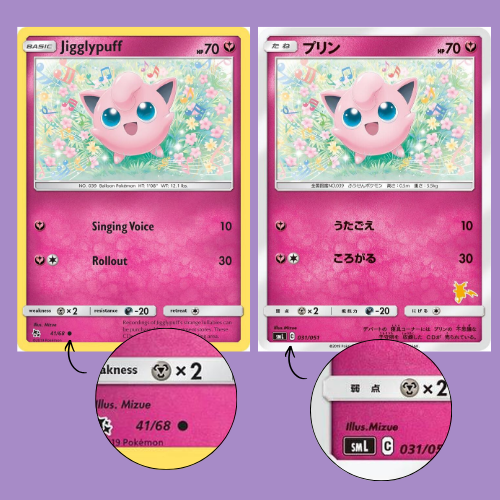
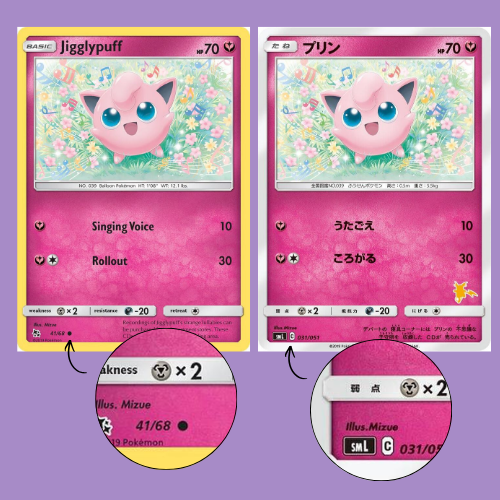
On modern Pokémon cards, look toward the bottom of the card, where you’ll find information such as the card’s collector number and expansion information.
The rarity symbol is located in this lower information area.
PHOTO IDEA: Take a close-up picture of one of your own Pokémon cards and add an arrow pointing directly at the rarity symbol.
This is one of those things that’s much easier to understand when you can actually see it.
It’s also important to check what set and era your card belongs to. Pokémon’s rarity system has evolved over the years, so an older card shouldn’t necessarily be identified using the same rules as a newly released card.
Common Pokémon Cards — Circle ●
Let’s start with the easiest rarity to identify.
A Common Pokémon card is represented by a solid black circle in the Scarlet & Violet rarity system.
Common cards make up many of the cards you’ll encounter while opening packs and are likely to make up a substantial portion of a collection over time.
That doesn’t make them useless, though.
Common cards can still be important for completing sets, building decks, collecting a favorite Pokémon, or filling themed binders.
And remember: Common describes rarity—not how much you should like the card.
If your favorite artwork in an entire set happens to be a Common, that’s still a great card for your collection.
Uncommon Pokémon Cards — Diamond ◆
Next up is Uncommon.
Uncommon Pokémon cards use a solid black diamond.
Once you start sorting a large Pokémon collection, learning the difference between the circle and diamond makes separating Common and Uncommon cards much faster.
Uncommon cards can include Pokémon and Trainer cards, depending on the expansion.
Rare Pokémon Cards — Star ★
A traditional Rare Pokémon card is identified by a solid black star in the modern rarity system.
This is where beginners sometimes start assuming that “Rare” automatically means they’ve found an expensive card.
Unfortunately, it’s not quite that simple.
The star tells you the card’s rarity classification within its set. It does not tell you the card’s current market value.
We’ll get into that distinction later because it’s an important one for collectors.
Double Rare Pokémon Cards — Two Black Stars ★★
With the Scarlet & Violet Series, Pokémon introduced the Double Rare classification.
Double Rare cards are represented by two solid black stars. Pokémon originally introduced this category for Pokémon ex, including Tera Pokémon ex.
So if you pull a modern card and see two black stars near the bottom, you’re looking at a Double Rare.
This is an easy symbol to learn once you’ve seen it a couple of times.
Illustration Rare Pokémon Cards — One Gold Star
Now we’re getting into one of my favorite parts of modern Pokémon collecting: the artwork.
An Illustration Rare is represented by one shiny gold star in the Scarlet & Violet rarity system.
Illustration Rares feature full-card artwork that can show Pokémon in their environments or give us a completely different artistic interpretation of the character.
These are especially fun if you’re the type of collector who cares as much about artwork as rarity.
You also don’t have to be chasing expensive cards to enjoy Illustration Rares. Building a binder around artwork you love can be just as satisfying as trying to complete an entire set.
Ultra Rare Pokémon Cards — Two Shiny Foil Stars
Ultra Rare Pokémon cards are represented by two shiny foil stars in the Scarlet & Violet rarity system.
Pokémon introduced this designation for more exclusive full-art foil versions of cards such as Pokémon ex and certain Supporter cards.
This is a good example of why learning the actual rarity symbols is useful.
Instead of looking at a card and thinking, “It’s shiny and looks fancy, so it must be really rare,” you can check the symbol and identify its official rarity classification.
Special Illustration Rare Pokémon Cards — Two Gold Stars
Special Illustration Rare, often shortened by collectors to SIR, is another modern Pokémon card rarity.
These cards use two shiny gold stars.
Special Illustration Rares can feature alternate-art versions of cards such as Pokémon ex and Supporters with elaborate full-art illustrations.
If you enjoy collecting cards because of their artwork, Special Illustration Rares are definitely a category you’ll become familiar with.
They’re also different from regular Illustration Rares, so pay attention to whether you’re seeing one gold star or two.
Hyper Rare Pokémon Cards — Three Gold Stars
See three shiny gold stars?
That’s a Hyper Rare.
When Pokémon introduced the Scarlet & Violet rarity system, Hyper Rare cards were represented by three shiny gold stars. Pokémon described these as full-art foil cards featuring gilded borders and accents and noted that this rarity succeeded cards previously known as Secret Rares.
This makes the basic modern progression easier to remember:
Pokémon’s current card database includes many rarity classifications beyond the core Scarlet & Violet categories, including older or set-specific classifications such as Rare Holo, Radiant Rare, Shiny Rare, Shiny Ultra Rare, Amazing Rare, ACE SPEC rare, and others. It also now lists newer classifications associated with more recent products.
What About Foil/Holo Pokemon Cards?
Another thing that can trip up new collectors is foil.
A shiny card doesn’t necessarily represent an entirely different rarity classification.
Pokémon refers to parallel foil cards within the Scarlet & Violet Series. These cards retain their Common, Uncommon, or Rare rarity symbols while receiving a foil treatment.
In other words:
Foil treatment and rarity aren’t always the same thing.
Check the actual rarity symbol rather than deciding rarity based only on how shiny the card looks.
More to Learn Pokemon Questions
Does a Higher Pokémon Card Rarity Mean It’s More Valuable?
Rarity and value are not the same thing.
A card’s rarity tells you its classification within the Pokémon TCG set.
Its market value is something different.
What do the rarity symbols on Pokémon cards mean?
Rarity symbols indicate the rarity classification of a card within its Pokémon TCG expansion. In the Scarlet & Violet system, the core symbols range from a black circle for Common through various star combinations for higher rarity classifications.
What do two gold stars mean on a Pokémon card?
Two shiny gold stars represent a Special Illustration Rare. Don’t confuse this with Ultra Rare, which Pokémon represents using two shiny foil stars.
What is an Illustration Rare Pokémon card?
An Illustration Rare is a rarity featuring alternate full-card artwork of Pokémon. Pokémon introduced the classification with the Scarlet & Violet Series, using one shiny gold star as its symbol.
What’s the difference between an Illustration Rare and a Special Illustration Rare?
In the Scarlet & Violet system, Illustration Rares use one shiny gold star, while Special Illustration Rares use two shiny gold stars. Special Illustration Rares were introduced for alternate-art cards such as Pokémon ex or Supporter cards.
Is every holographic Pokémon card rare?
No. A foil or holographic treatment doesn’t automatically tell you the card’s rarity. For example, Scarlet & Violet parallel foil cards can retain Common, Uncommon, or Rare symbols. Check the card’s actual rarity symbol and set information.
Why doesn’t my older Pokémon card match these symbols?
Pokémon’s rarity system has changed over time, and older sets can use classifications that differ from the modern Scarlet & Violet system. Pokémon’s official card database still recognizes numerous historical and special rarity categories.
How can I tell what set my Pokémon card is from?
Look at the information toward the bottom of the card, including its expansion information and collector number. Identifying the set first will make determining the correct rarity much easier.